
Premise: a backwards case.
Our Task: Create a backwards case like Memento
You can see start of case at https://demo.openlabyrinth.ca/labyrinthManager/global/2485
Authoring Process
We are going to explore this case bass-ackwards. Just like in the movie Memento, we are going to start with the conclusion and then work backwards to establish what happened. And as a homage to the movie premise, there is memory loss involved and you have to work out what happened.
We are also going to explore the authoring process in OLab as part of our narrative, to illustrate the use of the Designer canvas as a concept mapping tool which can help you to map out your ideas as you go along. This is also going to be a little bit bass-ackwards.
Normally, to get going with a case design, we recommend that you start with a simple 3-step model:
- Set your context
- Set your 3-4 main learning points
- Decide your conclusion and feedback
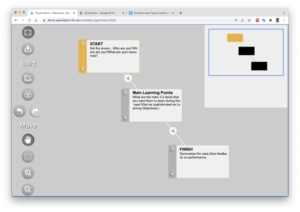
Now, let’s turn this around right away so that we are working backwards, right from the beginning.
Note that in the layout where you place Nodes upon your design canvas, their relative positions on the page does not matter at all. While we tend to naturally progress from left to right and top to bottom, this is not relevant to how the pathways evolve when the map is played.
The pathway and options available are solely determined by the Links or arrows. Mathematically, this would be considered as a Directed Graph. So, in this map, we can continue to move from top-left to bottom-right as a cognitive convenience, or we can change the orientation to whatever makes sense to us.
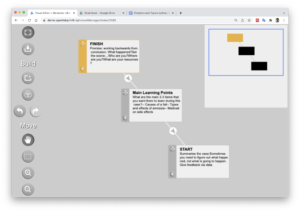
However, we can turn the direction of the Links around so that we are now working backwards from Finsh to Start, because that is how we want the narrative or case play to progress.
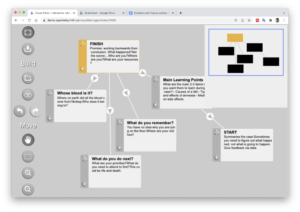
Now we can use the Designer canvas as a true concept mapping tool. Add some Nodes that contain some of the options or narrative possibilities for the author, or learner, to consider.
So, in this case, you have just woken up on the bathroom floor and there is blood everywhere. You don’t remember what happened or how you got there. Some immediate questions arise: whose blood is it? Yours? Do you remember anything at all? What the heck do you do next?
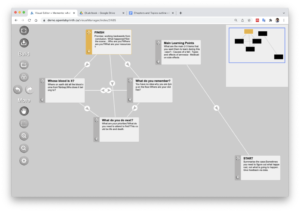
You can also use the Designer canvas to map out some of the pathway options at this point. For example, you may decide to ignore one possible line of enquiry: of course, it’s your blood – there is nobody else around (or is there?). Once that pathway is taken, it might close off other actions and possibilities. This can be set into your available pathway choices, even at this early stage in your design.
Don’t be afraid to do this early on because it is very easy to change these links and pathways later. It can simplify your design process to close off certain areas.
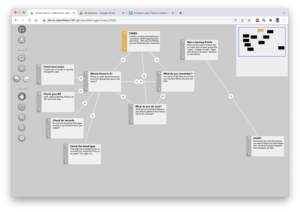
Sometimes these options can be easily interchangeable; sometimes they will be mutually exclusive. This, too, is easy to map out with the Nodes and Links.
At this point, you could explore how you might confirm whether this blood is yours, and whether this might be serious or just messy. Is your pulse rapid or slow? Might you be in shock? Are you getting worse? Can you check your blood pressure? You do remember that you are a healthcare professional so this should be easy to do. Do you have any obvious wounds?
What is the blood type – yes, you can introduce distractors into the case, even at this early stage. The Designer canvas is your freeform notebook. You can jot down such notions for later consideration. And you can easily delete them if not practical. After all, who the heck is able to determine blood type out in the field?
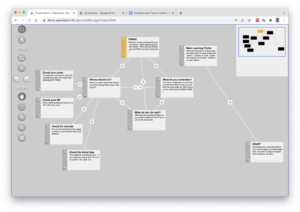
You can also leave Nodes on the Designer canvas, but not linked into the main pathway. For example, in the above example, you can leave a reminder about the Main Learning Points for ongoing reference. But because they are not linked into the main pathway, they will not appear as content when the learner navigates the case.
Indeed, you can de-link whole segments of the case if you don’t need them, or just as easily link them back in, should you change your mind later.
In our own case design here, there are all sorts of interesting concepts that you can choose to include. You could make this a whodunnit? Has some evil purpose been foiled and you have survived their dastardly attempt on your life.
Or are you just a demented, doddery old klutz who fell off the toilet? Is your memory loss recent or long-term? How would you know? You don’t remember. Is it the result of your fall and hitting your head? Or did you just have a dizzy turn or a medication side effect (notably one of the commonest causes of falls).
There are all sorts of ways that you could flesh out this case. Remember to keep coming back to your Main Learning Points. You are not trying to teach everything there is to know about falls, or memory loss in one single case.
Themes or Questions to consider
- Use falls risk and amnesia as theme
- Start with being on bathroom floor with blood everywhere
- Whose blood?
- Check pulse: high/low; rising or falling; vasovagal or hypovolemic
- Check medicines in cabinet
- Patch on arm: fentanyl or hrt or nicotine or nitro or scopolamine?
- Pee on floor: seizure or were you peeing before you fell (micturition syncope)?
- Tinnitus: Meniere’s or ASA toxicity or labyrinthitis
- Look closely in bathroom mirror for nystagmus: this could be a false clue because you would suppress it if you look closely
- Bleeding from scalp or nose? : if you make it nose then can pass on tips about where to apply pressure
- Nausea but no D&V: from concussion or was it causation?
- Short vs long-term amnesia
- New memories going forwards?
- Smashed phone so cannot call 911; just canceled landline contact; or be at mountain cabin so no cell signal
- In house alone because they are out walking the dogs but you don’t know that
- Tepid tea on counter
- Just out of hot tub: vasodilation
- Footprints in snow from tub: how many sets?
- Trail of blood leading to bathroom? Blood loss before fall?
- How long were you out for? Clues to this. Hypothermic or not?
- Wearing nothing: where are your clothes?
- Korsakov’s vs concussion vs meds
- Alcohol: cause for blackout? Vasodilation? Interaction with meds?
You can jot all these points down in a traditional linear fashion, as above. Or you can continue using the concept map as note pad while building the case. You can also leave unfinished segments for later consideration, or to make a more complex case for more advanced learners.
Other scenarios
You could use this case design in other learning scenarios:
- Pathology-oriented case
- Autopsy, working back to find cause of death
- Base it on Tutankhamun or a similar mummy
- Arsenic levels, assumed to be cause of death, but arsenic consumption was common back then
- Carbon-dating as one of the investigation options
Conclusion
Or should we have started with this?
The main point here is that your design canvas can be so flexible. Use it to map out your ideas and concepts.
Feel free to play around with the geography of your map. You can move whole sections of Nodes onto another area of your canvas, to get them out of the way if they are distracting you.
As with any Directed Graph, it is the Nodes and Links that determine its function.