
We often encounter debates around how much reality is important in virtual patient cases.
And, in this regard, what do we mean by ‘reality’? Is this represented by how life-like the images are in the case presentation? Should we be attempting to portray real talking heads and lifelike avatars?
For example, we were recently at an innovative technical demonstration of such a talking head, powered by a Large Language Model. In some ways, this was initially impressive. The animated head was able to convey crude expressions and emotion, albeit with some uncanny valley effects. Students apparently liked talking to this head, although it was unclear that the project demonstrated any change in learning or behaviours.
While technically impressive, it was educationally underwhelming. It mostly seemed to be yet another example of unnecessary bells and whistles attached to a virtual patient to make it more ‘realistic’. We have previously grumbled about not judging a book by its cover.
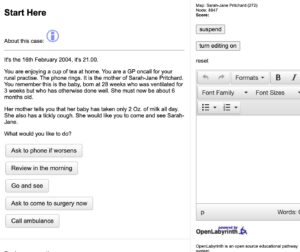
As a counter-example, we often quote the power of simple narrative and of creating a scenario where the context and challenges of the case are meaningful and realistic. Media can be helpful but are by no means essential. For example, the Sarah-Jane case created by Jonathan Round at St George’s University London has no pictures at all. It is just plain text. But the mental images are powerful and the case itself is challenging.
And do students take such cases seriously? For many years, a photo that featured repeatedly in SGUL’s presentations about virtual patients was that of a young female medical student, visibly in tears because she has just killed Sarah-Jane. Not surprising because this is a very engaging case and is quite difficult to solve. It took me six attempts to save Sarah-Jane.
You can try the case yourself at https://player.olab4.net/272/0
The choices and decisions portrayed in the case are all credible and convincing. This is not your typical quiz where there is one correct answer and four distractors. You make decisions and deal with the consequences at each step. And one consequence is that she dies. Heartbreaking.
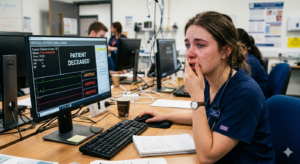
While we still have access to that original image of the tearful medical student, sadly the team at SGUL no longer have a record of its metadata such as copyright ownership, student consent etc. However, the principles conveyed by that image remain powerful and valid so we have attempted to create something similar using Google Gemini.
It still tells the story… which is the point of it all.